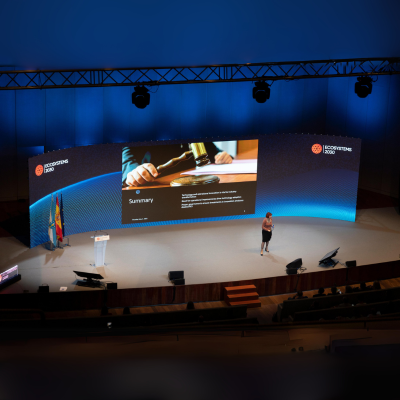


Miguel López-Valverde Argüeso was born in Bilbao in 1972. He holds a Master’s Degree in Telecommunications Engineering, specialising in Transmission and Communications, from the Technical University of Madrid (UPM), as well as a Senior Management Development Programme from IESE Business School.
He has held various professional positions in the field of Information Technology and has been involved in the healthcare and research sectors for more than 10 years.
He began his professional career in 1995 at Siemens, working in automation and communications consulting. In 1996, he joined Kern Datanet as a Communications Consultant. In 1998, he became Head of the development and evolution of Outsourcing projects at SemaGroup (now Atos).
In 2000, he joined Informática El Corte Inglés (IECISA), where he initially managed Information Systems Outsourcing projects and subsequently worked as a Senior Consultant on operational systems projects for the telecommunications and utilities sectors. In 2005, he created and organised IECISA’s Small and Medium-Sized Business (SMB) Department for El Corte Inglés.
In 2009, he began collaborating with the Life Supporting Technologies (LST) Department at the School of Telecommunications Engineering of the Technical University of Madrid (UPM), developing biomedical engineering research projects in Europe, an activity he has continued to pursue to date.
In 2018, as Director of Healthcare for Madrid and Castilla-La Mancha at IECISA, he was responsible for the SESCAM Medical Imaging Project (Ykonos VII). In 2021, following IECISA’s integration into Inetum (IECISA-GFI), he also took responsibility for managing transformational projects and initiatives for the Quirónsalud and Quirónprevención groups.
During the previous legislative term, he served as Director General of Information Systems and Digital Health at the Ministry of Health of Madrid. In this role, he initiated the most ambitious digitalisation process ever undertaken in Madrid’s healthcare system, including the launch of the Madrid Centre for Genomic Analysis, the development of services for the virtual health card, and the use of Artificial Intelligence in areas such as disease prevention and early detection, as well as the efficient use of medicines.












_03.jpg)